Oliveira, Minas Gerais
Hometown of Carlos Chagas · Central-West Minas Gerais
Oliveira is in Central-West Minas Gerais and has about 39,000 residents, according to the 2022 Census. It grew as a stopover on the route to Goiás and is crossed by major highways. It is the birthplace of the public health scientist Carlos Chagas, who discovered the agent that causes the disease named after him. Carnaval and Holy Week are among its best-known celebrations.
Oliveira at a glance
- Population: 39 thousand
- Area: 897 km²
- Elevation: 982 m
- Distance from Belo Horizonte: 150 km
- Demonym: oliveirense
- Founded: 1861 (town); village since 1839
- Region: Center-West
- Tourism region: IGR Campo das Vertentes
- Area code: 37
- IBGE code: 3145604
Oliveira is part of the tourism region IGR Campo das Vertentes.
History
The settlement arose around the middle of the 18th century, on a travelers' route to Goiás. In 1676, the Fernão Dias expedition passed through the region. A chapel already existed in 1758, and the mother church of Oliveira was completed around 1781.
There are two versions of the name. One speaks of olive trees (oliveiras) that the first settlers supposedly found. The other, more widely accepted locally, recalls Dona Maria de Oliveira, whose house stood where the town is today.
Growth came from cattle ranching, farming and trade with travelers, not from mining. After abolition, immigration brought Syrian-Lebanese settlers, who came to dominate commerce, as well as Portuguese and Italian influence. The parish was created in 1832, the town (vila) in 1839 and the city on September 19, 1861.
Timeline
- 1676 · The Fernão Dias expedition passes through the region
- 1758 · A chapel already exists in the settlement
- 1781 · Approximate completion of the mother church of Oliveira
- 1832 · Creation of the district of Nossa Senhora de Oliveira
- 1839 · Raised to town (vila) status (Provincial Law no. 134)
- 1840 · Installation of the town, on June 9
- 1861 · Raised to city status (Provincial Law no. 1,102)
Things to do in Oliveira: attractions
Estátua do Cristo Redentor
Viewpoint
Large statue of Christ, one of the city's symbols.
Casa de Cultura Carlos Chagas
Museum
Cultural space dedicated to the memory of the scientist born in the city.
Antiga Igreja Matriz
Church · Centro, Oliveira
18th-century Baroque church.
Catedral de Nossa Senhora de Oliveira
Church · Centro, Oliveira
Gothic-style church with Romanesque features.
Boulevard
Square · Centro, Oliveira
Central area for strolling and socializing.
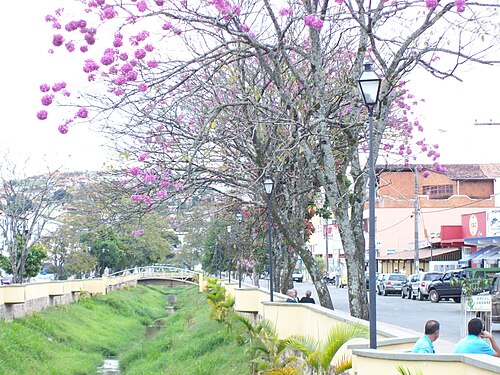
19th-century manor houses
Heritage · Centro, Oliveira
Group of old mansions that tells the city's history.
Heritage
- Antiga Igreja Matriz · 18th-century Baroque church.
- Casa de Cultura Carlos Chagas · House dedicated to the scientist from Oliveira.
Nature
- Rio Jacaré · Tributary of the Rio Grande, it rises in Oliveira and São Tiago and supplies the town's water.
- Rio Lambari · One of the main rivers that supply the town's water.
Rivers and waters
- River basin: Plata basin, between the Plata and São Francisco slopes
- Rivers: Lambari, Jacaré
Climate
- Type: Highland tropical (Cwb)
- Winter: Mild to cold. It has recorded 0 °C, in 1979.
- Summer: Mild to hot. Record high of 35.5 °C, in 2014.
- Best time to visit: May to September, the driest season.
Festivals and events
- Carnaval e Cainágua (Feb) · Highlights include the Cainágua, inspired by the masked revelers of Venice, and the Pelo amor de Deus street band.
- Holy Week (Mar) · Traditional Holy Week religious celebrations.
- Congado · Traditional festival of Afro-Brazilian culture.
Fun facts
- Carlos Chagas, born in the city, was nominated for the Nobel Prize.
- The city is crossed by three major highways and by the Barra do Paraopeba railroad line.
- The local airport has the ICAO code SNRZ.
- It has one of the largest emergency hospitals in Central-West Minas Gerais.
Getting there
- Belo Horizonte · About 150 km to the southwest, by highway
Districts
- Morro do Ferro
Notable people from Oliveira
- Carlos Chagas · Public health physician who discovered the agent that causes Chagas disease and was nominated for the Nobel Prize
People born in Oliveira
- Alberto Valentim · Futebolista brasileiro · b. 1975
- Alexandre Gonçalves do Amaral
- Capitã Pedrina
- Carlos Pinheiro Chagas · Brazilian politician. 48th Governor of Goiás · 1887–1932
- Djalma Pinheiro Chagas · Político brasileiro · b. 1884
- Efigênio Salgado dos Santos · Brazilian politician
- Eliseu Resende · Brazilian civil engineer and politician · 1929–2011
- Emílio Haddad Filho · Brazilian lawyer · 1938–2009
- Gabriel de Andrade · A Brazilian physician
- José Adolfo Moura · Brazilian musician and researcher · 1943–2026
- José Maria Pinto · Brazilian politician
- José Oiticica · Writer, poet, university professor · 1882–1957
- Lucas Lasmar
- Maurício Chagas Bicalho · Brazilian Lawyer · 1913–1999
- Nathan Silva · Futebolista brasileiro · b. 1997
- Olavo Romano · Writer · 1938–2023
- Paulo Haddad · Economista brasileiro · b. 1939
- Paulo Pinheiro Chagas · Brazilian physician and politician · 1906–1983
- Paulo Romano
- Raimundo Nonato Ferreira · Político brasileiro · b. 1970
- Ramiro Noronha
- Salim Mattar · Brazilian businessman, partner and chairman of the board of Localiza
- Silvio Carvalho Mitre · Político brasileiro · b. 1947
- Werley Ananias da Silva · Futebolista brasileiro · b. 1988
- Áureo Ameno · Brazilian journalist · 1933–2025
City hall
- Mayor: Erik Assis Castro (Dr. Erik) (Solidariedade), term 2025–2028
- Address: Praça Xv de Novembro, 127, Centro, Oliveira, MG, CEP 35540-000
- Phone: (37) 3331-9800
- Website: www.oliveira.mg.gov.br
Frequently asked questions
Where is Oliveira?
Oliveira is a municipality in the state of Minas Gerais, Brazil, in the Center-West region, 150 km from Belo Horizonte.
What is there to do in Oliveira?
The attractions of Oliveira include Estátua do Cristo Redentor, Casa de Cultura Carlos Chagas, Antiga Igreja Matriz, Catedral de Nossa Senhora de Oliveira, Boulevard, Casarões do século XIX.
What is the population of Oliveira?
Oliveira has about 39 thousand inhabitants in an area of 897 km².
When is the best time to visit Oliveira?
May to September, the driest season.. The climate is highland tropical (cwb).
How do you get to Oliveira?
Belo Horizonte: About 150 km to the southwest, by highway.
Who was born in Oliveira?
Notable people from Oliveira include Carlos Chagas, Alberto Valentim (brazilian footballer), Alexandre Gonçalves do Amaral, Capitã Pedrina, Carlos Pinheiro Chagas (brazilian politician. 48th governor of goiás), Djalma Pinheiro Chagas (brazilian politician), Efigênio Salgado dos Santos (brazilian politician), Eliseu Resende (brazilian civil engineer and politician).
Which tourism region is Oliveira part of?
Oliveira is part of IGR Campo das Vertentes, one of the 47 official tourism regions of Minas Gerais, with 15 municipalities.
What are the festivals of Oliveira?
Carnaval e Cainágua (Feb), Semana Santa (Mar), Congado.
What are people from Oliveira called?
People born in Oliveira are called oliveirense.
Towns near Oliveira
- São Francisco de Paula · 16 km in a straight line
- Carmo da Mata · 16 km in a straight line
- Carmópolis de Minas · 27 km in a straight line
- Santo Antônio do Amparo · 29 km in a straight line
- Cláudio · 29 km in a straight line
- Camacho · 35 km in a straight line
- Passa Tempo · 35 km in a straight line
- Bom Sucesso · 38 km in a straight line